
At D Custom Boxes, we’ve seen it all: boxes that were too big, packages that got returned, and shipments that cost double because of measurement mistakes. You wouldn’t think how many individuals guess their box dimensions and cross their fingers. Here’s the fact: How to Measure a Box Correctly, you will avoid headaches, save money, and ensure your load or storage job is done exemplarily.
This guide is a no-nonsense walkthrough for anyone who likes to get the size of a box right, whether you are sending something necessary, ordering packaging for your business, or just trying to organize your garage.
Why Proper Box Measurement Matters
Think about this: You buy a custom box, only to find out your product doesn’t fit, or you ship something light, but in a big box, and get slammed with extra charges because of dimensional weight.

That’s where D Custom Boxes come in. We help customers like you avoid those costly mistakes every single day. And it all starts with knowing how to measure your box correctly.
What You’ll Need
Before you begin, grab these essential means:
- A measuring video(preferably soft and flexible, but a traditional ruler functions too)
- A pen and something to document on (or just use your phone’s notes app)
- The actual container, fully assembled and closed
That’s it! You don’t need fancy equipment. Just a little attention to detail.
The Three Key Dimensions: Length, Width, Height
No matter the shape or size, every box has three main measurements. Always list them in this order:
- Length – the longest side of the base
- Width – the shorter side of the base
- Height (sometimes called depth) from the bottom to the top when the box is upright
Pro Tip from D Custom Boxes: Think of a pizza box. When it is sitting or lying on your aircraft, the size is left to right, the width is front to back, and the height is how elevated the box stands.

How to Measure a Box
1. Measure the Length
Place the box on a flat surface. The longest side on the bottom is your length. Use the tape measure from edge to edge.
Write it down.
Example: 14 inches
2. Measure the Width
Still working from the bottom of the box, measure the shorter side, which is the width.
Add it to your list.
Example: 9 inches
3. Measure the Height
Now, measure from the bottom of the box to the top. That is the height of your box. If the box has flaps, keep them closed during measuring.
Record it.
Example: 6 inches
So for this box, your full dimensions would be written as:
14 x 9 x 6 inches
This is the industry standard, and it’s what we use at D Custom Boxes when making your custom packaging.
Measuring the Inside of the Box (When Fit Actually Matters)
If you are packing a development inside the box and it ought to fit snugly, you will need the interior measurements:
- Open the box completely.
- Measure from inside wall to inside wall, not the outer edges.
- If the box is thick (like double-wall cardboard), subtract a bit to account for the material.
At D Custom Boxes, we ask clients for inside dimensions when designing inserts or precise fit packaging.
Shipping Boxes: Why Accurate Measurements Save You Money
Most carriers like FedEx or UPS don’t just care about weight. That is why it is important to count exactly and round up to the nearest inch.

Here is the calculation:
Length × Width × Height
Example:
14 x 9 x 6 Shipping companies then use a procedure to estimate what they will trust you. That is why it is worth double-checking your dimensions every inch.
D Custom Boxes Tip: If you are creating boxes for bulk shipping, talk to us first. We can help you design sizes that minimize shipping costs without sacrificing presentation.
Advanced Tips from D Custom Boxes
If you’re a small company owner, a craftsperson, or just somebody who cares about facts, these suggestions can help:
- Use a digital caliper if you’re operating with tiny or delicate creations.
- Checking your units properly during measurement in Inches and centimeters is typical.
- Measure twice and cut once. Even with boxes, this age-old advice applies.
FAQ:
Q: Do the flaps count in the height?
A: Yes, if you are measuring a box as it will be shipped. Measure it fully closed.
Q: Is it always length x width x height?
A: Yes. That’s the universal order, and it’s what we follow at D Custom Boxes.
Q: What if my box isn’t a perfect shape?
A: Measure the widest points. For oddly shaped boxes or cylinders, you will want the diameter and height.
Want to Calculate Volume?
Here is the basic volume formula:
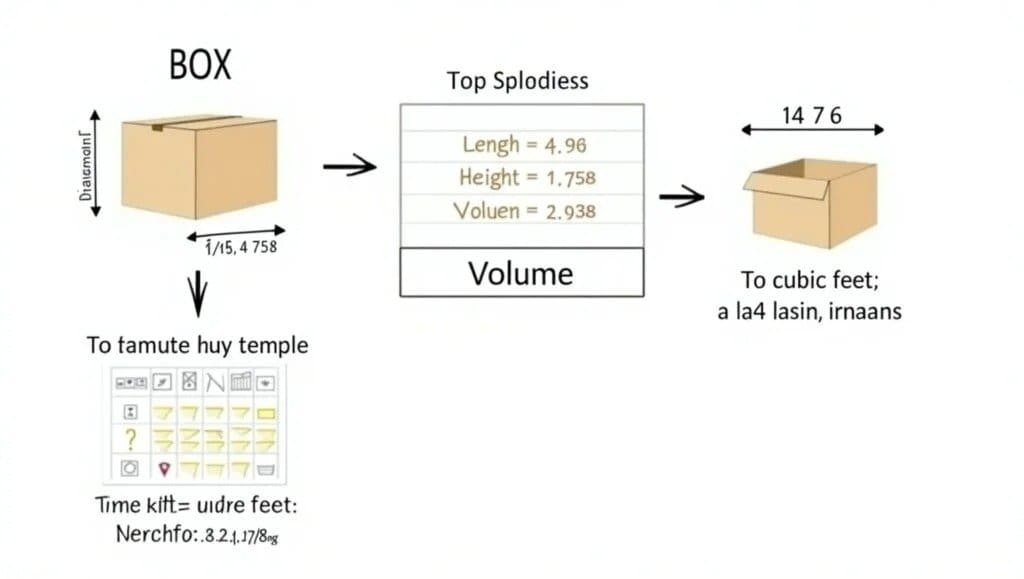
Volume = Length × Width × Height
Example:
14 x 9 x 6 inches
This helps when you are figuring out the exact storage of your box or even how many boxes fit in a Carton.
Final Thoughts from D Custom Boxes
We know it is just a box. But getting the dimensions right? That’s what makes the difference between an okay experience and a smooth, professional one.
At D Custom Boxes, we believe packaging isn’t just about looks. It’s a close fit, process, and it makes your life more comfortable. If you are learning how to estimate your box size properly, we are here to help you get the exact dimensions for you.
So next time you have a tape measure in hand, remember:
Length × Width × Height.
Write it down. Double-check. You will thank yourself later.
If you need help selecting the right dimensions for your packaging? Reach out to us at D Custom Boxes. We are real people who care about getting your packaging just right.